
.png?command_1=resize&width_1=430&height_1=430)
.jpg?command_1=resize&width_1=430&height_1=430)




Vol 6 Ed 26 2025-2026 SY 17 April 2026 JU
Dear CIS Community,
Something to Ponder
“I'm not going to buy my kids an encyclopedia. Let them walk to school like I did.” - Yogi Berra
Last week, our Honour Choir and Honour Band students were in Panama performing at the Latin America AMIS (Association for Music in International Schools) Choir and Band Festival. You may recall that last school year, CIS hosted the Latin America AMIS Choir Festival.
Next week, CIS hosts the CISA (Caribbean International Schools Association) Sports Tournament, in which close to 500 high school student-athletes from international schools in the Caribbean islands will participate in football (soccer), basketball, and volleyball.
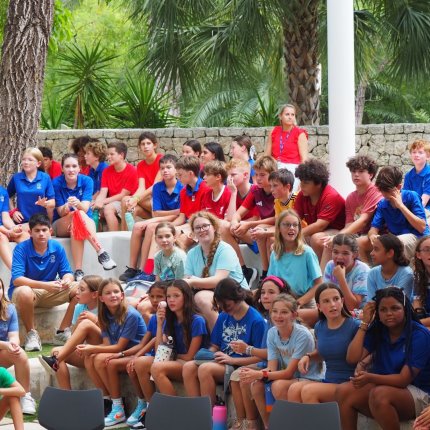
Music and athletic performances in front of large audiences create a special atmosphere. Indeed, people can gain extra motivation and put forth effort in the presence of an audience - particularly when the artistic or athletic endeavour is familiar. This phenomenon is often described as social facilitation.
It is interesting how the presence of an audience - and the words of encouragement or discouragement they offer - can vary across different activities and people. At its best, an audience can increase motivation and help a person or team perform at their optimal level. At its worst, too much pressure can lead to stress, causing individuals or teams to feel overwhelmed and perform poorly.
For example, the audience at a concert is different from one at a football(soccer) game. A grandparent talking with a grandchild creates a different dynamic than a conversation between siblings. Parents watching their child in a school performance experience something different from watching a movie at home. Similarly, the audience in a classroom differs from that of a music lesson. The list goes on and on.
Do such differences make sense? Does the behaviour of an audience help or hinder the people being watched? Does shouting things when watching young people make sense?
What if your child was playing an instrument in a theatrical or music performance? Would you shout things like, “Come on! Speed it up! Slow down! Great song! For crying out loud, put your fingers on the right note! Hey, conductor, change the music!” Similarly, would you go to every rehearsal and shout or cheer while your child is practicing? Or would you talk to the conductor after the rehearsal and suggest that your child should be playing percussion instead of strings? Would doing any of the above make sense?
What if you were observing your child in the classroom? Would you cheer things like, “Read faster! Write slower! Look what the other person is doing, why don’t you do that! Come on - keep your head up and be ready for the next question! Turn the page, or you’ll miss it! Would you... Boo! Start clapping slowly and gradually build up to fast clapping!” Would doing any of the above improve a child’s learning in class or while working at home?
What if your child were playing a sport, yet we treated it like a theatre or musical performance? Would we do things like wait until the end of the game to clap and cheer very loudly - so loudly that the players come back out to play another half of football? Would we bring flowers to the athletes afterward, thank the coaches and remain silent while the game is being played?
Would doing all, or even some, of these things help our children?
The way we act as audience members and communicate with our children, family members, and friends varies greatly depending on the situation, our own experiences, and our cultural perspectives. It also differs in tone, body language and timing. If there was an absolute perfect way to provide feedback, schools, parents, and coaches would be doing close to exactly the same thing. The challenge is that no such perfect method exists. Fortunately, there are some guidelines for providing feedback that transcends school, sport, art, activities, teaching and parenting. These include ensuring that feedback is Kind, Specific and Useful. When we support others - regardless of the endeavor - feedback that is Kind, Specific and Useful tends to help people learn over time, whether at play, at work, at home or at school.
We hope to see you at future sporting events where you can join in group cheers, appreciate artistic performances celebrating the human spirit, and support our learning celebrations that foster young people’s growth.
Sincerely,
Jim
Jim Urquhart
Director - Cayman International School